A little secret some of us parents harbor: We might grumble about listening to kids’ songs on repeat yet find ourselves grooving to Kidz Bop or singing “Let It Go” – even when the kids are nowhere in sight. (It’s not just me, right?)
Maybe it’s the mood boost of head-bopping music that gets us. But we international folks in Switzerland have another justification for digging kiddie tunes: Music can us help pick up another language! I for one owe a good deal of Schwiizerdütsch comprehension to car-ride singalongs.
I had studied German and lived in Germany for several years but moving to Switzerland was unexpected. In the meantime, I have birthed 2 of my 3 children here and even became a citizen, but really mastering Swiss German has eluded me. My reasons (excuses?) are myriad, including:
- There’s no official written language and there are so many different dialects.
- In public, people tend to switch to English after I utter two syllables in German.
- And I speak English at home and increasingly at work, so it’s harder to feel immersed in the local language.
But I still want, at minimum, to understand Swiss German – even if I barely dare to pronounce much more than Grüezi and Adé. Integration is one motivation, but the strongest might be having children. Swiss adults might kindly accommodate me with High German or English, but little kids here often speak only dialect, the language of their ‘Mamis’ and ‘Papis,’ playgroups and friends. So to understand kids’ chatter over z’Vieri on a play date, at least some Swiss German is essential.
At first, I seemed only to pick up little bits of Swiss German at a snail’s pace until we started to acquire some music and stories in dialect. Then one day, as I pressed play again on one of the CDs, an aha! moment struck me: I understood (some of) the text! And who did I have to thank? The Swiss kiddie recording artists!
Partaking in any form of media in German or Swiss German can definitely help, but music made for kids and families might have simpler structure and vocabulary to aid language learning. And though the market for Swiss German is, of course, smaller than for many other languages, Switzerland is home to a vibrant scene of children’s entertainment. High German options also abound on Spotify, YouTube, CD retailers or wherever you prefer to find music.
The following are some of my personal favorites and tips. They’ve helped improve my German and Swiss German skills and comprehension, all while bopping along with my kiddos:
Sagadula
Sagadula offers parent-child sessions for little ones to try different instruments, sing songs, dance and play. These hours provided great fun and warm memories, while the CD collections songs helped reinforce the texts. That in turn helped me (and probably my little ones) make sense of more phrases in Swiss dialect.
Bonus: One of the CDs includes the theme to the old Pippi Langstrumpf TV show. Learning it is practically a legal requirement here.
Schwiizer Kiddies
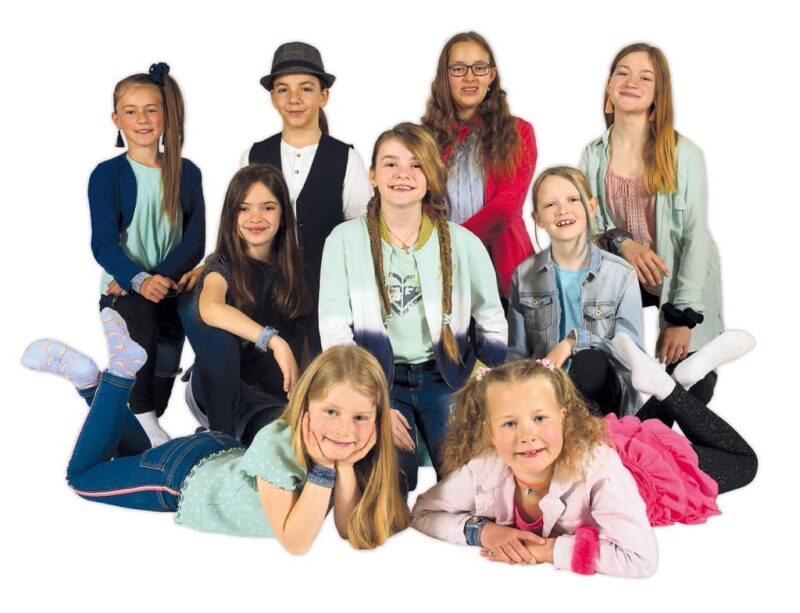
Schwiizer Kiddies is a group of kids ages eight to 12 (think family-friendly Spice Girls, Jr.). They churn out one earworm after another, mostly in Swiss German, often in a style somewhere between catchy German Schlager and pop. In studio albums, YouTube videos and in concert, they dance and sing about chilling in summer, goofing around with friends, finding comfort in the 1,000 stars on a lonely night, snowboarding, taking care of the environment or partying with pirates or dinosaurs.
They even rock some ‘Swissified’ covers, such as Nena’s “Irgendwie, Irgendwo, Irgendwann” – a huge hit in these parts and so awesomely ‘80s. Their concerts get all the kids and parents dancing along, and the Kiddies are good for a lot of energy, fun and humor.
Full-disclosure: My eight-year-old sings and dances with the Schwiizer Kiddies. (Yes, it’s as much fun as it looks, and yes, she and her buddies would love it if you follow them on Spotify, YouTube, social media or come to a concert!)
Andrew Bond
Andrew Bond is one of Switzerland’s most beloved children’s songwriters and musicians. He came into our lives when my now-17-year-old played an angel in a Christmas Eve production of his musical “Di allereerscht Wienacht,” with songs that are catchy, funny, and all-around delightful. The musical vibes are as upbeat as the messages (e.g. ‘the biggest present doesn’t sit under the Christmas tree’), and the incidental Swiss German training is priceless.
Now, years later, my daughter’s little siblings still come home from kindergarten and school singing gems that turn out to be Andrew Bond creations, such as the charming “Marrini, Marruni, Marroni,” about roasted chestnuts.
Bonus: «Zimetschtern han i gern,» a very beloved Swiss Christmas favorite to the tune of “Jingle Bells,” is also a brilliant primer on Swiss Christmas cookies!
Seek Familiar TV Show Songs
Seek translations of songs and TV shows you’re familiar with in English. Given that the target audience can’t read subtitles, many of the most popular kids’ shows and movies get dubbed into German, and much popular adult fare gets translated, too. That creates an opportunity to listen to the same story in both languages, or at least to start out with an understanding of the concept.
One of my favorites for bilingual children’s viewing and listening pleasure was “Sesamstrasse” – that is, “Sesame Street.” It has its own catchy theme song in German and some local characters join the gang with Elmo, Ernie, Bert, and blue, googly-eyed Krummelmonster. But a number of classic songs and segments from the original children’s show were translated and equally beloved in the German incarnation. Some CDs and DVDs may still be found, but you can also unearth treasures on Spotify and YouTube. Remember Ernie’s “Rubber Ducky?” His voice might take getting used to, but Ernie’s “Quietsche-Entchen” is just as lovable in German as in English.
Bonus pro tip: As I discovered with a little Gen Z-er in the 2000s, while the original “Dora the Explorer” teaches Spanish words, the German version incorporates English. “Map heisst Karte!” Less vital to survival in German-speaking lands but also fun is hearing Swiper when he gets busted by Dora und Boots: “Oh Mann oh!”
Search out the Classics
When in Rome (or Switzerland): Listen to compilations of the best-known children’s songs in German or Swiss German on albums such as the “Schwiizer Chinderlieder” series. It’s so nice to understand your kids when they come home from kindergarten singing these tunes. I’m talking songs that are the equivalent of “Mary Had a Little Lamb” or “London Bridge”: Everyone has known them since childhood, so they feel like an especially lovely way to grasp both the language and the culture.
Once upon a time, my toddler wanted to sing a song nonstop and I could make no sense of the lyrics tumbling forth, despite being fairly fluent in standard German. Her daycare kindly copied the song for me and then I found it – “Det äne am Bärgli” – on YouTube so we could sing it together. Those sweet moments singing childhood standards would be such a simple, natural part of parenthood in my home country but are impossible here without some understanding of the local language. I learned both not to take those moments for granted and to find joy discovering new-to-us classics together.
Final pro-tip: Searching “Schweizer Kinderlieder» and similar variations (e.g. Schwiizer Kinder Musik) on Spotify or similar channels yields countless options. Incorporating even a few local ditties between other favorites helped train my brain to better hear the local language. Spotify now displays lyrics for many songs, which can help make connections that strengthen language confidence, too.
About Beth

Beth Demain Bayley is a freelance writer and German-English translator as well as an Open Access publishing specialist. Originally from the US, now married to an Aussie, Beth has lived in Switzerland since 2005 – first in urban Basel, and now in the countryside in the sweet spot between Zürich, Zug and Luzern.
Mother to three, ages 17, 8 and 6, Beth’s perfect weekend would involve a combination of family, travel and exploring, books, comedy or theater, and perhaps a walk in the mountains for good measure.
Follow Beth on Instagram .