Liebe Laura
So how are you? And how goes the new school routine? I hope you have all settled in well.
Our last letters and the discussion on different names for school levels had me all confused!!! It doesn’t help that on the german-side alone there are differences. One thing that is the same all over this side of the Röstigraben is we start counting grades from first grade, the year after kindergarten, where, like Little Z, the children are 6-7 years of age. But once sixth-grade finishes, that is where the differences arise
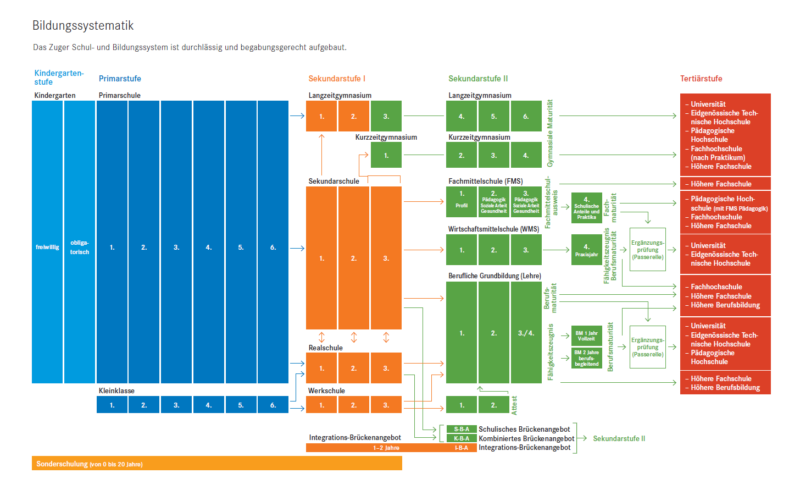
In canton Zug, after sixth grade, you are streamed into three levels. The top 20% go to (langzeit) Gymnasium, where they will stay for six years and work towards the Swiss Matura in either Zug or Menzingen. The rest remain in their village and move into Sekendarschule/Real or Werkschule, depending on academic ability. Most stay there for three years, where they go on to do either an apprenticeship, attend a professional orientated school or move into a 4-year (kurzzeit) Gynamisum to complete the Matura. It’s best explained on this graph from the canton.
But it is not the same in cantons like Aargau, Thurgau or Schwyz, where it looks similar to you; they don’t move to a Gymnasium until after the third year of high school – so around 15/16. So to answer your question, the school where they work towards a Matura would be the equivalent of the Gymnasium. For such a small country, this is all a bit complicated! It can be a nightmare for anyone moving cantons in high school, with a different organisational system.
But no matter what school you are in Switzerland, what they do have all in common is an encouragement of learning languages. Be that a national exchange programme in high schools like my eldest did, or international exchanges between third and fourth grades at Gymnasium (around 16). But it is also common to take a year off after completing a “Lehre” (Apprentischip) for language learning or going at some point in your early 20’s as you did with Florence. My husband did stints in France, the U.K and U.S, all in the quest to be better his language skills in his 20s. While our Teenager enjoyed her exchange with a girl on your side of the röstgraben, she would now rather spend a year in Australia and “practice” her English than six months somewhere in France. Although I think her wish is pandemic related because, unlike you, visiting Australia feels like an eternal impossibility right now. The border has been closed in Australia for 18 months, in and out, allowing only a capped daily number of people who hold an exemption. We feel homesick for our family and friends there whom we haven’t seen in over three years now. But I know the day will one day come, and I am sure, just like you, there will be tears of joy as we touch down in Brisbane.
But all of that is currently out of our hands, so I have decided to concentrate on what we can do, like enjoy Autumn in Switzerland. There is so much to do this time of year, and it feels like everyone is trying to stuff in as much fun as possible with events popping up everywhere—some new, like food festivals, and some traditional like Knabenschiessen and Alpabzug.
The late summer tradition in Zürich of Knabenschiessen (Literally translated to Boys Shooting) consisting of an actual shooting competition along with a “chilbi” (fair), including a Ferris wheel and even a day off school, was on the low-key side this year, and the fairground required a covid-certificate for entry. (Read more about it from Swiss Family Fun – here). And the “Alpabzug” – where the cows come down from a summer of grazing on alpine pastures – calendar looked a little bare at first, but it seems like many people were still able to get out and enjoy this very swiss tradition. But that hasn’t stopped people from getting out on the weekends and enjoying this late-summer weather. It feels like everyone has been saving their event for September!
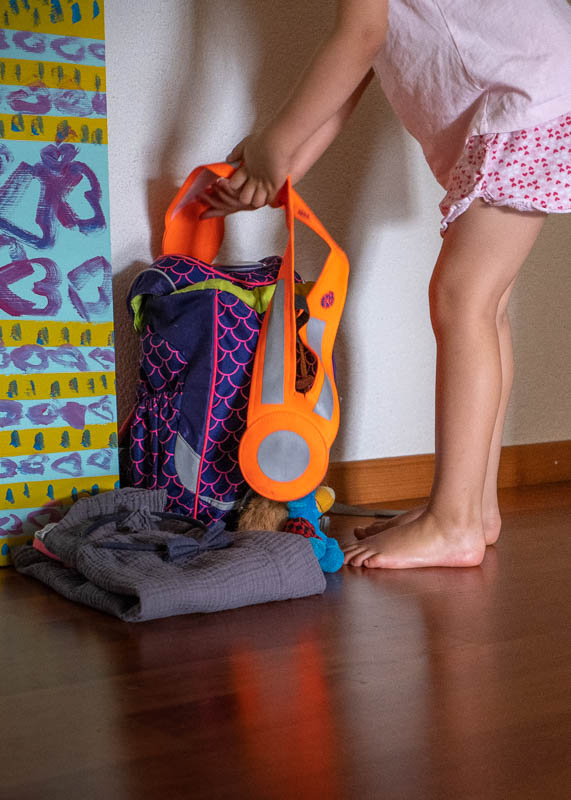
Our September would have been a little bit hectic if it wasn’t for me getting sick. For about a week, I battled a sinus infection that had me missing a day out in Zurich, parent evening at school, and Little Z singing in Church for “Erntedänkfäscht” (Harvest Thanksgiving). She dressed up in her Edelweiss Shirt, slipped on a special vest and sung traditional swiss-german songs with a choir of local kids. I saw a video of their performance, thankfully, and they were utterly adorable.
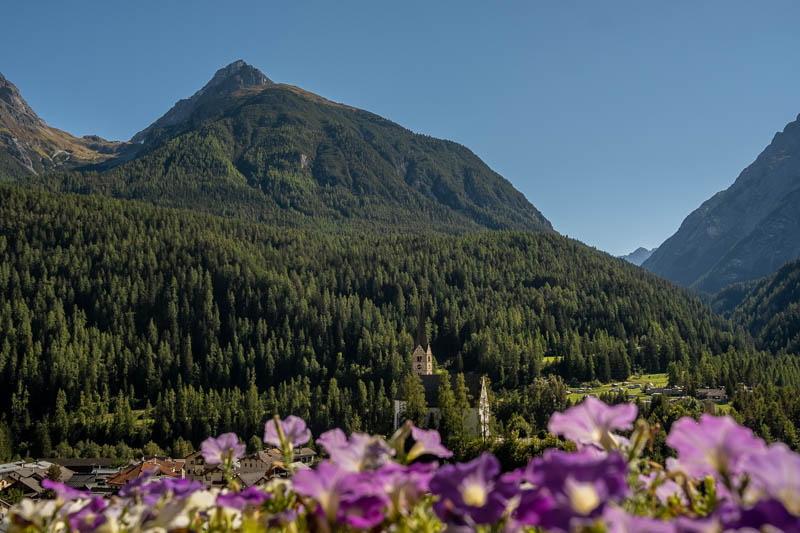

But thank goodness I recovered in time for our weekend to Scuol. We just got back from this long-awaited long weekend trip with the board of a local group in our village my husband is a part of. I love that so many local groups have a tradition of taking weekend trips like this as a way of bonding and thanking their team for their time commitment. And the best part? I didn’t have to plan a single thing. It was so lovely to see Scuol, a village we’ve seen often in winter, just as the leaves are about to change.
That trip away couldn’t have come at a better time, after a busy launch month. Did you notice? Since our last letter, Swiss Family Travel became z’Nüni – Storytelling from Switzerland. “z’Nüni” is the Swiss-german word for morning tea, a second breakfast, a mid-morning snack, taken at (zu) 9 (Nüni). But it is more than just a break to eat; it’s a time to connect – young and old – at school, at work or in cafes. Do you have a similar word like that in French?
Well, I should go and pack my suitcase!
Happy September,
Liebe Grüsse
Kristin
MAKE SURE YOU READ LAURA’S REPLY HERE.
AND KEEP UP WITH ALL OUR PAST LETTERS HERE.