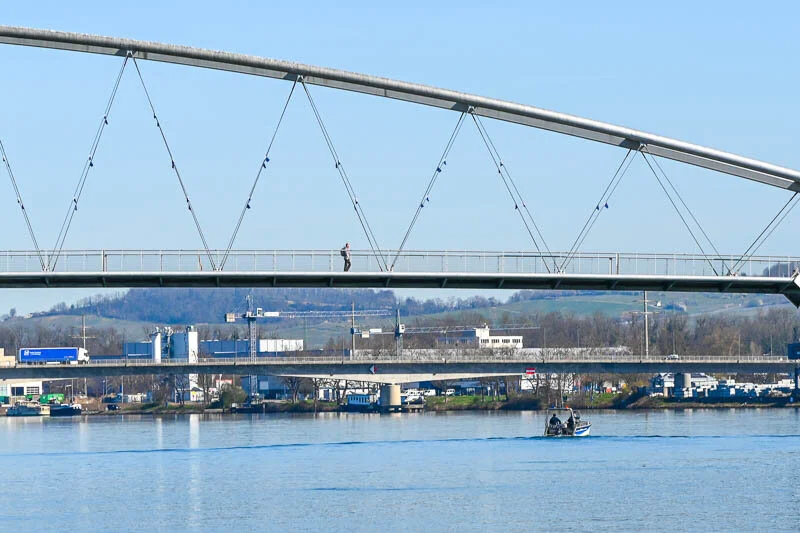
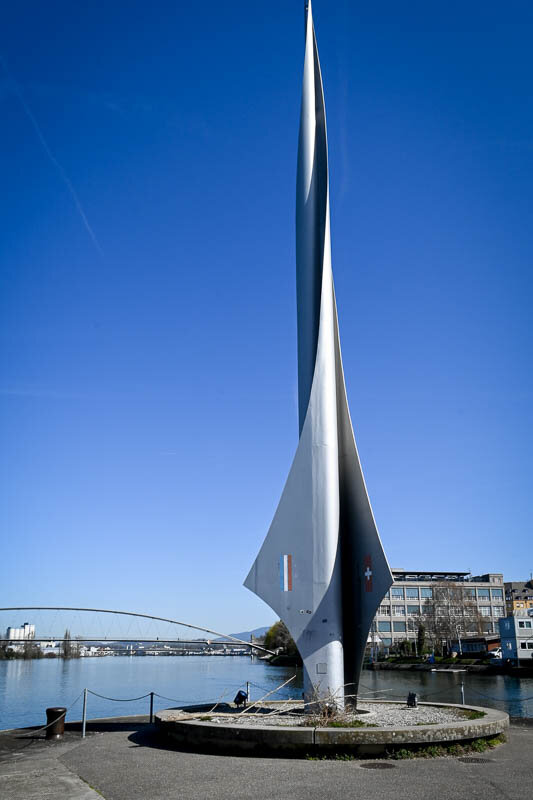
Over 1 million people are living in the ‘dreiländer’ region. From Basel Stadt and its surrounding cantons to Lörrach and Weil am Rhein in Germany and across to Alsace in France. Cars, trains, buses, boats, trams, bicycles and pedestrians straddle the borders daily for shopping, entertainment and outdoor activities. In addition to that, a staggering 60,000 workers cross the borders as part of their daily commute to work. Visitors fly in from all over the world to ‘Euroairport Basel Mulhouse Freiburg’ in another nod to this area’s tri-national status. When we first moved to Switzerland, we were lucky enough to be living a short walk away from ‘Three Countries Corner’, the exact spot along the Rhine where the three nations meet. This rather inconspicuous spot located in an industrial area at the end of a quiet towpath is nothing more than a graffiti-covered monument with a small information board. But look beyond that, and standing in the middle of the Rhein with your back to Switzerland, you will see Germany to your right, France to your left, and in front of you, the Dreiländerbrücke (the world’s longest single-span pedestrian and cycle bridge) connecting the two nations across the water. The mighty Rhein itself, such an important part of this relationship, flowing through all three countries bringing goods and people with it for centuries.
Where Switzerland, France and Germany meet
The three countries are so closely linked in this part of the world that it’s hard to imagine that it hasn’t always been this way. In actual fact, the region of Alsace has flip-flopped between French and German rule for the last 400 years, and as a result, its language, culture and food is distinctly different to the rest of France. You can find out more by visiting the Dreiländer Museum in Lorrach, Germany, where you will find collections and exhibits documenting this unique area’s history. Luckily, the three countries have a much more amicable relationship nowadays, and there are so many advantages to living in this fascinating part of Switzerland.
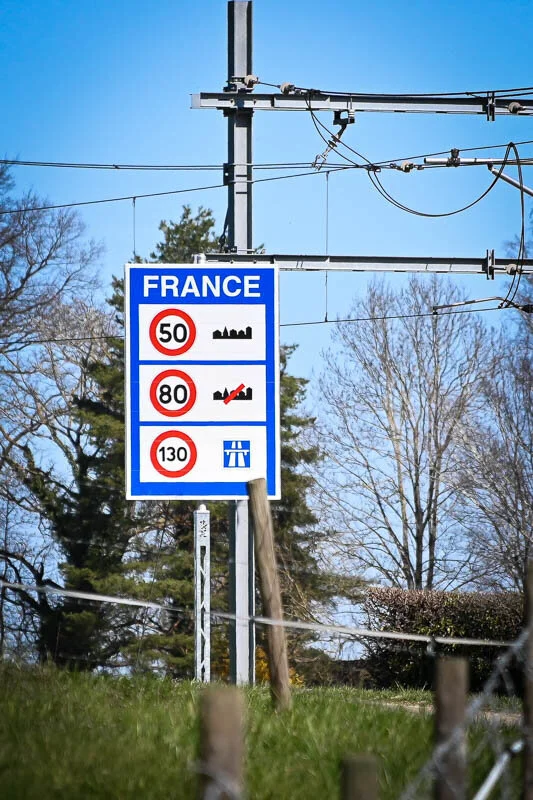
Popping over the border to shop
It’s no great secret that eating out, and grocery shopping in Switzerland is somewhat expensive. Knowing what options are available across the border can make shopping not only cheaper but also more varied. I have been known to shop in all three countries in one day, and as long as you remember your passport, it’s kind of fun! I can’t promise that I matched the correct language to the correct countries, but I came home with Swiss fondue, French wine and the kids’ favourite German sausages: so everyone was happy! As a Swiss resident, I am also entitled to a tax refund on my shopping. Simply ask for the required proof of payment at checkout, stop at the border, show your ID and get it stamped, then keep it safe until the next time you visit the store where you will receive the refund in cash or as money off your total. Sounds like hard work, but once you’ve done it a few times, it’s easy peasy and feels like a nice bonus at the end of your frantic checkout. In Germany, the checkout staff skilfully scan with alarming speed, and they then, through lack of a better word, hurl your items down the conveyor belt for you to hopefully catch and pack before the tsunami of groceries cascade on to the floor. The tax refund kind of feels like a little congratulatory prize for making it through what will almost certainly be the most stressful 5 minutes of your week.
France for lunch, Germany for dinner
When you have had enough of home cooking, it’s nice to be able to pop across the border for a relaxed French Sunday lunch or a Friday night steak dinner in Germany. Basel’s food scene has improved immeasurably since we moved here in 2014, but having three cuisines to choose from really is a lovely luxury.
Dreiländer Activities
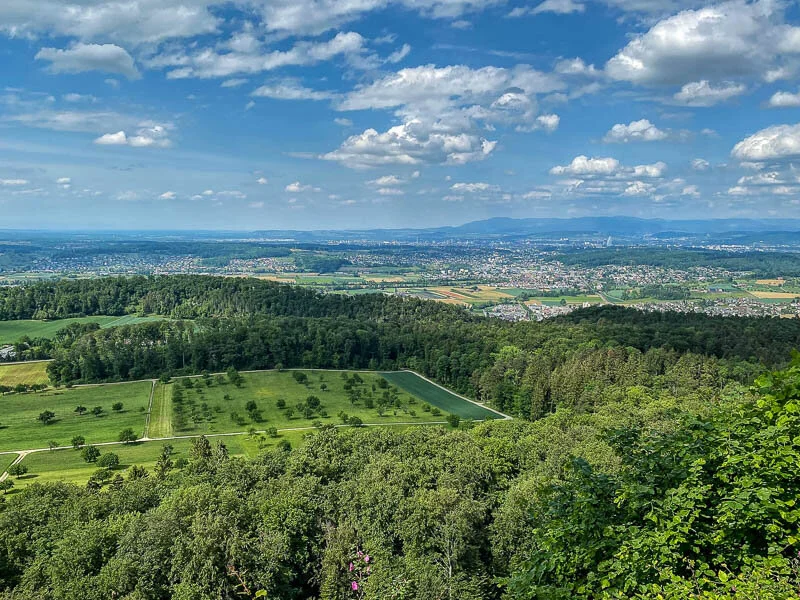
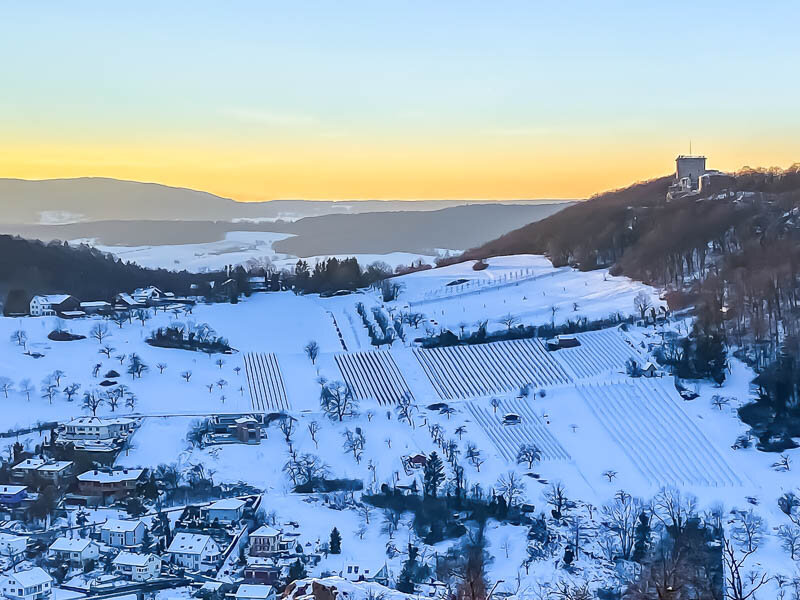
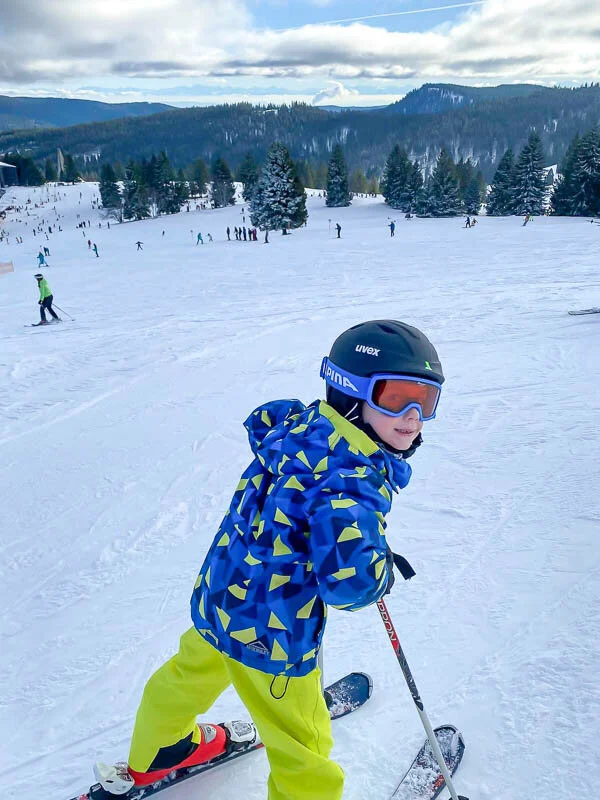
When it’s time to burn off all of this delicious food and get some fresh air, Basel’s close proximity to Germany’s Schwarzwald (Black Forest) and the Vosges Mountains in France add a plethora of possibility when it comes to outdoor activities. Stunning hikes, beautiful swimming lakes and a ski resort that ticks all the boxes for a fun few hours on the pistes. At 1493m, Feldberg is the highest point in Germany outside the Alps. The sweeping vistas across the Black Forest, the Vosges, the Jura and of course, the familiar sight of the Alps ranks among my favourites. Mont Blanc is even visible on a clear day.
During the winter months, I can drop my children at school, drive just under an hour to Feldberg (or jump in the car of a group of parents that all have the same idea as me), have 2 or 3 hours of skiing, grab a quick bite of lunch and make it back for pick up. It’s not uncommon to see groups of parents waiting for their children outside the school doors in full ski gear beaming with that post-ski glow.
In warmer months, keen cyclists head across to Alsace in their droves to take advantage of kilometre after kilometre of (relatively) flat roads and beautiful big blue skies. Runners can participate in the popular Dreilander marathon and wear their medal with pride, knowing that they raced through three countries. Want to combine your love of running with your love of French wine? No problem! The Marathon du Vignoble D’Alsace takes place every June and is one of the regions most popular events. Runners dress in wacky costumes and run routes of varying distances between villages and vineyards. There are 12 wine tasting stations and gastronomical delights along the way, so as you can imagine, it turns into quite the party-like atmosphere by the time you reach the end … if you reach the end.
Covid and closed borders
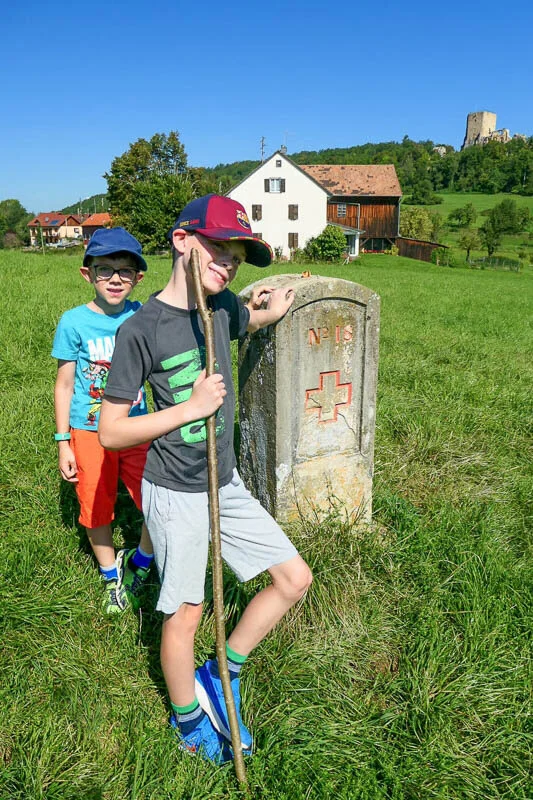
This last year has really made me realise how, as Swiss residents, we are so inextricably connected to France and Germany. The pandemic and subsequent border closures have affected our lives in so many ways. Our favourite family hike from our house cut short because we can’t continue along the hiking path into France. Shopping in Germany strictly forbidden. Best friends just a few kilometres away across the border, unable to visit for a casual cuppa and a catch-up. Cross border commuters and students not able to enter Switzerland without a bulging folder of paperwork detailing their exact reason for entering and then having to hurry home at the end of the day to make sure they don’t break the evening curfew. However, during all of this upheaval and uncertainty, the friendship and fondness between these three countries in the heart of Europe became more evident than ever before, sharing the intensive care burden and taking in covid patients when times got tough.
Throughout all the ups and downs of the last 13 months, cross-border solidarity has remained strong, the Rhine has continued to flow, and all three nations will emerge from these challenging times more connected than ever before. In a world full of uncertainty, of that, I am sure.