Once a year, a pungent cheese smell fills the entire stairwell of our apartment block. It’s my father-in-law, putting together his famous cheese fondue, a mixture of some of the best Swiss cheeses.
While he gave up making cheese long ago and closed his cheese grocery store twenty years back, we are so lucky he hasn’t lost his love of cheese. He gets his industrial cheese grater out each year just for us and we freeze that mix to enjoy across the seasons.
I married into a family of cheesemakers. My father-in-law was a cheesemaker; his father was a cheesemaker. My mother-in-law’s brother was a cheese maker. Her nephew is a cheesemaker, and his father was too. So one of the first things I learnt about food in Switzerland was an appreciation for cheese, and I’ve tasted a lot of it.
From Gruyère to Tête de Moine, below are ten types of Swiss Cheese I reach for constantly. They’re the ones that end up on my Friday night cheese board, on the brunch buffet when family stop by, and the ones I sneak pieces of from the fridge when no one is looking.
But I’m also going to share my least favourites. While cheese preference is personal, I’d hate for you to taste, say, that famous one with all the holes, and then swear off Swiss cheese for life. It doesn’t have to be that way. I’ll explain why I don’t like them, but also why you still might.
On to the list.
1. Tête de Moine AOP
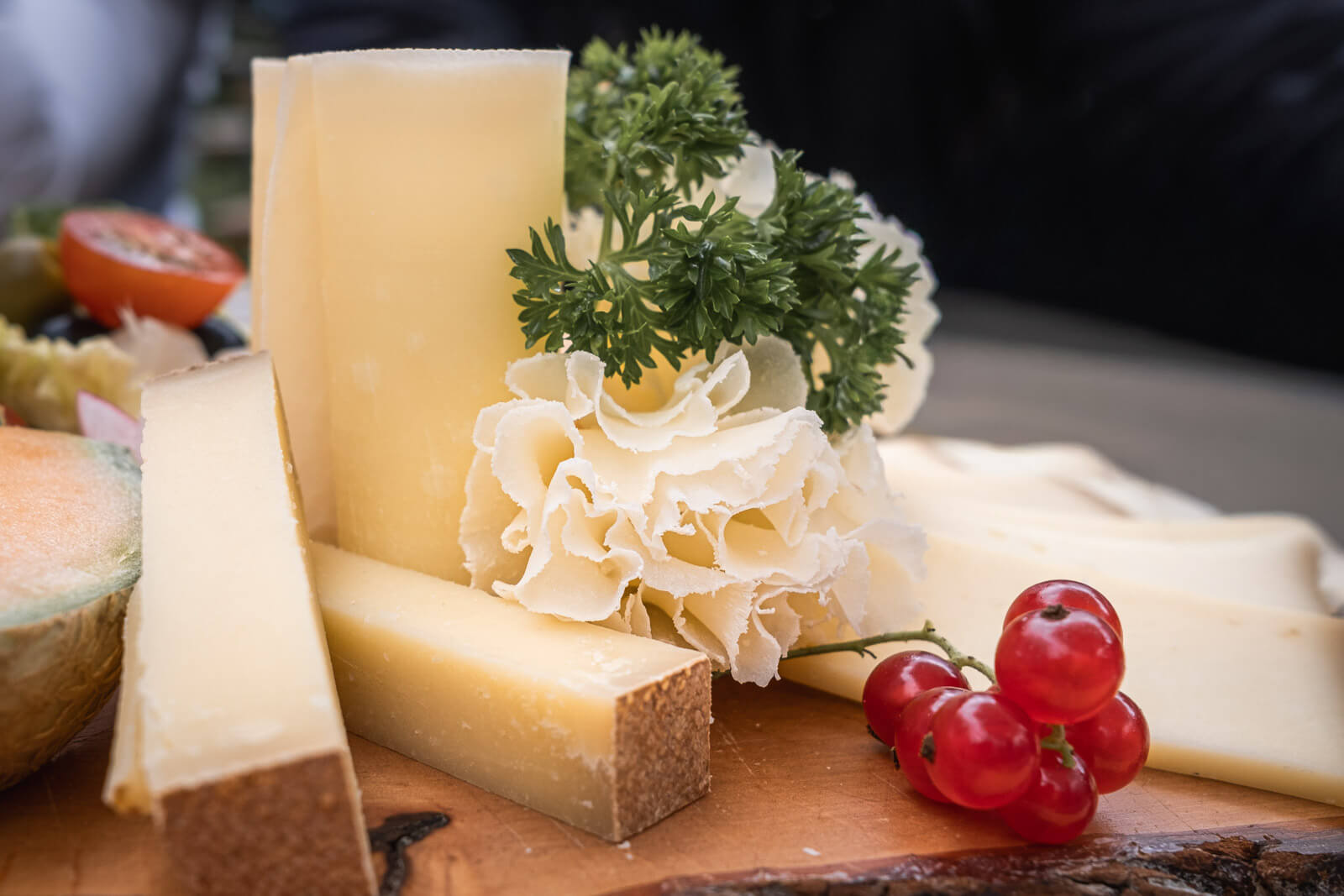
I am addicted to the rosettes that Tête de Moine turns into when you grate it on a girolle. There’s a distinct umami flavour that reminds me a little of Vegemite, and it’s best eaten freshly grated, when it stays light and moreish. Sure, you can buy pre-rolled rosettes at the supermarket, they’re perfect for a quick snack or to grab for picnics. But they’re nothing on the freshly grated ones, really at the top of my best Swiss cheeses list.
Tête de Moine translates to “the monk’s head,” and it’s sort of a special occasion cheese: we only get the girolle out when we have guests over for brunch. But whenever there are pre-grated packs on sale (often in packs of three) I grab one. This is the one I sneak from the fridge when no one is looking.
2. La Gruyère AOP, aka “Grossdadi chäs”
My father-in-law’s favourite, and what my kids call “grossdadi chäs”. Whenever it’s on sale he grabs a huge block, he and my mother-in-law are my thrifty heroes, for their evening dinner. They eat it cut directly off the block, and store it in the same Tupperware container with a blue lid, alongside their traditional cold dinner of bread, jam, cold cuts and Bircher muesli.
There’s always a block in our fridge too, but not just to eat with bread. Gruyère makes the best grilled cheese sandwiches, the best mac and cheese and Älplermagronen, the base for a béchamel — the list goes on.
It comes in different ages, and I prefer the rezent; I find the mild isn’t aged enough for me. For something special, I love the extra rezent, which crumbles as you cut it and is right at home on a cheese board.
Gruyère vs Emmental? In my opinion, Gruyère is the GOAT of Swiss cheese, and Emmental doesn’t even come close on my list. The town of Gruyères, The town of Gruyères, perched on its hill, is worth a stop on any visit to Switzerland.
3. Sbrinz AOP
This tangy Swiss cheese is Switzerland’s answer to Parmesan, and is exclusively produced in alpine dairies in Ob- and Nidwalden. It comes in blocks, in cubes ready for a cheese board, or thinly sliced and rolled up for the perfect snack. I actually prefer the rolled-up version, and grab a pack when I need to eat on the go.
We had chunks of Sprinz at our wedding apéro, drizzled in honey which proved to be very popular. The very best Sbrinz I’ve ever had was an alpine Sbrinz I tasted at the Cullinarium Alpinum alpine market one autumn. The cheese even has their own cellar there.
4. Fetta Berta
What I love about this extra-creamy soft cheese is that it has less of a pungent taste than its French cousins, but it is just as soft and delicious. Apart from a standard size, it also comes in perfect one-person portions, which is ideal since I’m the only soft cheese eater in my immediate family. This is the cheese I ALWAYS buy for a cheese platter.
5. Appenzeller
Brushed with a secret brine of alpine herbs, this is a Swiss secret slowly getting out there. It comes in different degrees of ripeness, from mild to stronger, and I like it as an alternative to Gruyère – I prefer the silver label. The limited regional area where this cheese is produced (Appenzell Innerrhoden/Ausserrohden and parts of St. Gallen) enables the unique taste to stay constant, an over-700-year tradition.
6. Any “Berg” Cheese
I’m a sucker for any cheese labelled Berg (mountain) cheese, and I’ll always give it a go. My favourite is the one made in our own village, my family prefers the mild, I prefer the rezent (are you noticing a pattern here?). In the supermarket I also like the Graubünden Bergkäse from Coop.
And whenever we’re in the mountains, I’ll seek out the local cheese shop to try the mountain cheese made locally. A lot of these cheeses are made in the Alps during the summer, and if sold directly after are usually quite mild. If you want something with more of a salty bite, look for aged versions.
7. Bachtaler Cheese
Since my father-in-law closed his grocery store twenty years ago, this Swiss cheese is a little harder for me to come by. But if you live in the Zürich Oberland, keep your eyes out for Bachtaler.
Again, the rezent is my favourite — it just crumbles when the knife slices through, but there are also mild versions too. The cheese is made from cow who have been eating exclusively hay.
8. Cheese from the Wildberg Käserei
Speaking of the Zürich Oberland, my next favourite happens to come from my husband’s cousin’s cheese factory. I like most of their cheeses, but I love the unique smokiness of the Chämifäger (“chimney sweep” cheese), as well as his Wildbach cheese, an award-winner at the Swiss Cheese Awards.
9. Raclette du Valais AOP
What would a best swiss cheeses list be without raclette cheese?
We always have a slab in the fridge for emergency meals, summer or winter, because no, it isn’t only a cold-weather cheese.
The one we keep in stock is plain in flavour, the standard Migros brand my father-in-law always buys. But the moment we expand and invite guests, it’s straight to the nearest cheese shop to try all the flavours. Well, its me trying all the unique flavours like truffle, pink pepper corn and port wine. I have even ordered raclette flavours online, like from Jumi, to test them. The rest of the family likes it more traditional: plain, green pepper, paprika and garlic.
10. Tilsiter
The red one. Always the red one. Not the milder green, not the creamy yellow, my favourite of this cheese brand from Thurgau is the flavourful surchoix red cheese. Nobody puts Tilsiter on a “best Swiss cheese” list internationally, and I think they are missing out.
My Favourite Swiss Cheese on the French Side: L’Etivaz, Vacherin Mont d’Or and Co.
A few famous names are missing here, and the honest reason? Where you live, and the language you speak does shape the sort of cheese you eat day to day.
Favourites like L’Etivaz and Vacherin Mont d’Or are delicious, but they are cheeses from the Romandie, the French side of Switzerland, so they don’t appear often in my central Swiss fridge. I probably only dip my toes into these cheeses once or twice a year. If you do go looking for Vacherin Mont d’Or, note it’s seasonal, roughly October to April.
One exception: Vacherin Fribourgeois AOP. We don’t eat it regularly in our rotation, but a portion always makes it into our fondue when my father-in-law mixes it himself.
The Famous Swiss Cheese I Never Buy (Sorry, Emmental)
If I’m completely honest, Emmentaler AOP rarely appears on cheese platters in our region, and I personally think it is overrated. I can hear your gasps from across the oceans.
Sometimes my sister-in-law will add Emmental to her cheese platters, but it’s a rare occasion. And in fondue, on our side of Switzerland? Never, ever.
A tourist thinks Emmental IS the best of Swiss cheeses, but it only makes up a small part of more than 700 types of Swiss cheese.
I’m yet to taste an Emmental I love, but I’m willing to have my mind changed.
The same goes for Luzerner Rahmkäse, and really any of these spongy cream cheeses. I find them almost pointless: not enough flavour, too spongy a texture. But funnily enough, my eldest loves the Luzerner Rahmkäse, and will often ask for single portions. So remember: it always depends on which type of cheese you enjoy.
How to Read a Swiss Cheese Counter
A few words that will get you further at a Swiss Chäsi than any guidebook:
- Rezent (reh-TSENT) — well-aged, sharper, more crumbly. My default.
- Mild (milt) — younger, softer, gentler. What most of my family prefers.
- Surchoix (sur-SHWAH) — French for “extra select”; on a label it signals a higher, longer-aged grade.
- Chäsi / Käserei (KASE-er-eye) — the cheese dairy, where it’s made. A village Chäsi often sells straight from the source.
- Chäs (khaas) — Swiss German for cheese.
- Chäs-Chessi (khaas-KHESS-ee) — the big copper vat the milk is heated in.
- Rohmilch (ROH-milsh) — raw, unpasteurised milk. Where the depth of flavour comes from.
- Bergkäse (BAIRG-kase) — mountain cheese, made at altitude.
- Alpkäse (ALP-kase) — made up on the alp during summer grazing, in limited quantity. If you see it, buy it.
- AOP (ah-oh-PAY) — Appellation d’Origine Protégée. A protected origin label: The cheese must be made and aged in its home region.
Best Swiss Cheeses, FAQ
Gruyère and Emmental are the best known internationally, but in German-speaking Swiss households the best Swiss cheeses and everyday favourites run wider — Gruyère, Appenzeller, raclette and Tilsiter all earn regular spots in the fridge.
Vacherin Mont d’Or is seasonal, available roughly from October to April.
Rezent means well-aged — sharper and more crumbly than a mild cheese. It’s my default choice across nearly every variety.
The holey cheese sold abroad as “Swiss cheese” is usually based on Emmental, but it’s only one of more than 700 Swiss cheese varieties, and not one I personally reach for.